Squarespace vs. an Astro Template: The Real 5-Year Cost
A website builder subscription feels small until you multiply it by 60 months. We ran the numbers on Squarespace, Wix, a freelancer build, and a bought Astro template — including the exit costs nobody prices in before signing up.
Every small business owner asks the same first question: what does a website cost? And almost every article answers it wrong, because they price year one. You do not own a website for a year. You own it for five, or ten, or as long as the business runs.
The honest comparison is total cost over the years you will actually keep the site — including the cost of leaving if you ever want to. That last number is the one nobody puts on a pricing page.
So here it is: four realistic paths for a service business website (a law firm, a renovation crew, a consultancy — five to ten pages, a contact form, maybe a small blog), priced over five years. The numbers use published 2026 plan pricing where it exists and typical market rates where it does not.
Path 1: Squarespace
Squarespace’s entry plan runs around $16–25/month billed annually (list pricing moves with promotions; the pattern is what matters). For a business site you will realistically want the mid tier for features like code injection and broader template control — call it $20–35/month.
Five-year math:
| Item | 5-year cost |
|---|---|
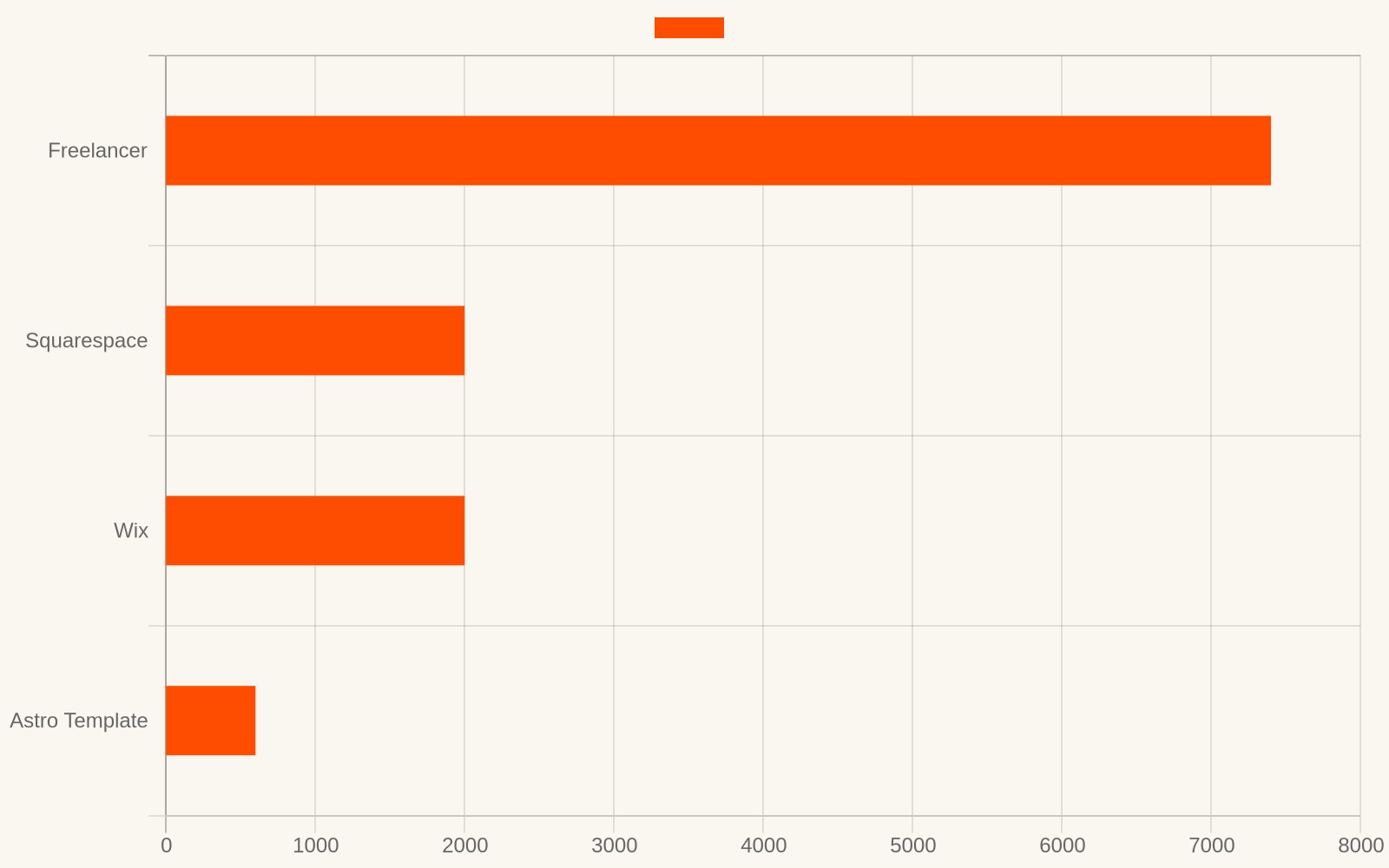
| Plan (~$25/mo average) | ~$1,500 |
| Google Workspace email (~$7/user/mo) | ~$420 |
| Domain after free year | ~$100 |
| Total | ~$2,000 |
What you get for that: a genuinely good editor, hosting handled, no maintenance, and templates that look professional on day one. For a business owner who will never touch code, that value is real.
What you do not get: control. Squarespace sites routinely score in the 30s–50s on mobile PageSpeed, and the cause is platform JavaScript you cannot remove. Search r/squarespace and you will find years of threads from owners who compressed every image, converted to WebP, and still watched the platform’s own scripts dominate their Lighthouse report. The SEO community’s blunt consensus: it is the architecture, not your images.
And the exit: Squarespace exports a fraction of your site. Content leaves in pieces; the design does not leave at all. When you outgrow it, you are rebuilding from near zero wherever you go next.
Path 2: Wix
Wix’s business tiers land in roughly the same band, $17–35/month, with a lighter entry tier that omits things you’ll eventually want (like removing Wix branding, or analytics).
The five-year total is nearly identical to Squarespace: ~$1,800–2,200 all-in with email and domain.
Performance is the same story, with an extra wrinkle: Wix sites load through Wix’s infrastructure, and the platform’s own bundles are the biggest thing on the page. Wix Studio’s rendering improvements help, but you are still renting an architecture whose priorities are editor experience first, payload size second.
Wix’s export situation is the hardest of the builders. The official export produces a kind of content snapshot that is not directly importable anywhere. Your site lives in Wix or it gets rebuilt by hand.
Path 3: A freelancer or agency build
Market rate for a 5–10 page custom site from a competent freelancer: $2,500–6,000 upfront in most Western markets. Agencies quote more.
Then hosting and maintenance, forever:
| Item | 5-year cost |
|---|---|
| Build (freelancer, mid-range) | ~$4,000 |
| Hosting + maintenance retainer (~$30–50/mo) | ~$2,400 |
| Small updates and fixes (hourly, inevitable) | ~$1,000 |
| Total | ~$7,400 |
You get exactly what you asked for, built properly, with someone accountable. For businesses with specific needs or no time, this is still a legitimate answer.
The risks are timing and dependency: good freelancers book out weeks ahead, and when they disappear, you inherit a bespoke codebase that the next developer has to learn. A custom build is portable in principle, but portability depends on the code being ordinary enough for the next person to read.
Path 4: A bought Astro template
This is the path this site sells, so take the numbers with appropriate skepticism and check them yourself.
A production-grade Astro template costs $50–100, once. Deployment on Cloudflare Pages or Netlify is free at small-business scale. The site is static HTML: no platform JavaScript, nothing you cannot remove, PageSpeed scores in the high 90s as the default state rather than a project goal.
| Item | 5-year cost |
|---|---|
| Template (one-time) | ~$79 |
| Hosting (Cloudflare Pages free tier) | $0 |
| Google Workspace email | ~$420 |
| Domain | ~$100 |
| Your time (initial setup + learning) | 1–2 days |
| Total | ~$600 |
The catch is the last row of that table. You are the developer now. Setup is a day, not an afternoon — clone the template, edit config, deploy. When something needs changing, you change it or you hire someone who can. Templates with a config-driven structure keep that barrier low (you edit one file, not forty components), but the barrier exists.
The compensations: the site is plain files. Any static host serves them. Any developer can work on them. Moving from Cloudflare to Netlify to a $4 VPS is an afternoon, not a migration project. Nothing is rented except the domain, and you own the domain wherever you bought it.
What the numbers actually say
Stacked side by side:
| Path | 5-year cash | Your time | Exit cost |
|---|---|---|---|
| Squarespace | ~$2,000 | Low | Rebuild — design not portable |
| Wix | ~$2,000 | Low | Rebuild — export is a snapshot |
| Freelancer | ~$7,400 | Medium (briefing, review) | Depends on the codebase |
| Astro template | ~$600 | Medium (setup, then rare edits) | Near zero — plain files |
Three honest conclusions:
The builder subscription is not expensive; it is recurring. Two thousand dollars over five years is a defensible price for never thinking about your website. The problem is what the subscription buys: an architecture you cannot optimize and an exit that costs a rebuild. You are not paying $2,000 for a website. You are paying $2,000 to rent one.
The freelancer path buys accountability, not assets. At 3–12x the template cost, what you are actually purchasing is someone else’s judgment and calendar. Worth it for many businesses — but ask any candidate you hire what happens to the site if they stop answering email. If the answer involves a shrug, keep shopping.
The template path front-loads competence instead of cash. $600 total, but the entire difference is denominated in your time and willingness to touch files. If that trade sounds bad to you, it is bad — buy the builder subscription without guilt. If it sounds fine, you will spend less over five years than a Squarespace customer spends in eighteen months, and the asset at the end is yours in every sense.
The question under the question
Pick based on what you are actually optimizing for, not the sticker price:
- Optimizing for never thinking about it → Squarespace. Accept the performance ceiling and the rebuild-in-your-future.
- Optimizing for control and long-term cost → template. Accept that “someone else’s problem” is now a field on your calendar.
- Optimizing for a specific, complex outcome → freelancer. Accept the price and vet for portability.
The only genuinely wrong answer is picking a builder because it looks cheapest in month one and discovering in year four that the design you paid to refine, the SEO you built up, and the content you wrote all live inside a platform you cannot take with you. Price the exit before you buy the entrance.
Want a site this fast?
Browse our Astro themes. Full source code, SEO-ready, yours forever. From $79.
Browse themes →